
By: Timothy B. Spruill
In: Ground water monitoring review, vol.8, No. 3
Abstract
Water samples collected from 26 sites at an abandoned oil refinery in south-central Kansas were analyzed for total organic carbon (TOC) and specific volatile and semivolatile organic compounds by gas-chromatography/mass-spectrometric methods. Results from a Spearman-rho correlation analysis between TOC concentration and the number of compounds identified (correlation coefficient = 0.71) and TOC concentration and total concentration of compounds identified (correlation coefficient = 0.83) indicate correlations significant at the 0.01 level.
Although TOC data alone would not be sufficient to evaluate hazards posed by oil-refinery wastes, results of the correlation analysis performed using data collected from the site in Kansas indicate that TOC data can be used effectively to delineate petroleum-related ground water contamination and to help identify sources of ground water contaminants. TOC data collected from a large number of temporary sampling points during the initial phases of an investigation will provide an estimate of the extent of hydrocarbon contamination and allow placement of monitoring wells and more detailed sampling in appropriate areas.
Introduction
The U.S. Geological Survey, in cooperation with the Kansas Department of Health and Environment, began investigating ground and surface water contamination associated with an abandoned oil refinery in south-central Kansas during the fall of 1985. The abandoned refinery is located on unconsolidated sand and gravel of Pleistocene age in the Arkansas River valley. The site boundary and predominant direction of ground water flow are shown in Figure 1.
During the early phases of the investigation, 26 ground and surface water samples were collected in the vicinity of the abandoned oil-refinery site (Figure 1). These samples were analyzed for inorganic canons and anions, total organic carbon, and selected organic compounds. This paper will discuss the relationship between total organic carbon and the number and concentrations of organic compounds identified by gas chromatography/mass spectrometry at the refinery site. Based on these data, it appears that total organic carbon is an excellent indicator of ground and surface water contamination from the petroleum refinery site investigated in south-central Kansas. This finding has been useful for subsequent investigation at the site, which was directed at more specific delineation of contamination and identification of major ground water contaminant sources.
Petroleum as a Source of Water Contaminants
During the early 20th century, petroleum refineries commonly treated oil products with large quantities of sulfurinc acid to remove impurities. The acid sludge that resulted from such treatment frequently was disposed of on the ground or in unlined pits. In addition, spillage of petroleum products, which probably occurred at many refineries, could contaminate groundf water. There are about 900 abandoned and operating oil refineries in 42 states (Bigda 1982). About 130 of these refineries have identified hydrocarbon residue pits, and it is likely that many of the remaining refineries also may have such pits.
Petroleum is an extremely complex mixture that contains hundreds of individual compounds that can be categorized into several classes of compounds (Atlas 1981). In general, oil is composed of alkanes, cycloalkanes, aromatics and asphatic fractions, with refined products having different proportions of each of these fractions. Gasoline, fuel oils, kerosene, and other petroleum products contain 50 percent or less of the aromatic fraction (Coleman and others 1984). Acid sludge, generated by refineries that operated before 1940, is composed mostly of a complex mixture of high molecular-weight alkanes, aromatics, nitrogen-and sulfur-containing compounds, asphatic substances, and entrained oil (Kalichevsky and Kobe 1956).
Certain components of oil are very water soluble an can contaminate groun water. Coleman and others (1984) found that, even though aromatics comprised less than 50 percent of gasoline and other refined petroleum products, more than 93 percent, by weight, of the water-soluble fraction were aromatics. Thus, although aromatics do not form the major fraction of petroleum products, these compounds are the most water soluble and pose the greatest potential to contaminate ground water.
In addition, even though many components of oil and oil-waste products have small water-solubility values (for example, polynuclear aromatics such as chrysene and anthracene or high molecular-weight aliphatics such as heptacosane or heptadecane), wells developed in the vicinity of oilcontaminated sediments could draw water with sediment containing sorbed hydrocarbons or a water-oil emulsion containing many relatively water-insoluble compounds.

Figure 1. Sampling sites and direction of ground water flow at an
abandoned oil refinery, Arkansas City, Kansas.
Many of the organic compounds in oil products and wastes are included on the U.S. Environmental Protection Agency’s Priority Pollutant List (U.S. Environmental Protection Agency 1979). Table 1 lists the priority pollutant organic compounds that were identified in acid sludge and oil-contaminated aquifer sediment samples collected from an abandoned oil-refinery site in Arkansas City, Kansas (Figure 1). In addition to the many prioritypollutant compounds identified (all of which were polynuclear aromatics [PNA]), these samples also contained many alkanes, alkenes, cycloalkanes, and aromatic and polynuclear aromatic compounds, which were tentatively identified through use of the National Bureau of Standards mass-spectral library.
Volatile organic compounds, such as benzene and toluene, associated with refinery wastes and products generally are considered to pose the greatest environmental threat because they are more water soluble (and therefore potentially more mobile) than most semivolatile and non-volatile organic compounds. However, refinery wastes contain many organic compounds that can contaminate ground water and pose aesthetic, health and environmental hazards. Table 1 indicates that most compounds identified in oil- and acid-sludge samples also were detected in unfiltered ground water samples. Although many of the compounds detected are not very soluble (that is, they have solubility values less than a few micrograms per liter [pg/L]) and typically are not very mobile in ground water, refinery wastes are a source of contaminants that can cause localized ground water contamination.
Even organic compounds that have small solubility values may be mobile in the medium- to coarse-grained sand found in some alluvial aquifer systems. Sorption of typically hydrophobic polynuclear aromatic (PNA) and heterocyclic nitrogen compounds found in petroleum has been related to the organic carbon content of the soil (Karickhoff and others 1979, Means and others 1980). Although many organic compounds sorb onto soils containing 0.1 percent or more of organic carbon (Schwartzenbach and Westall 1981), those PNA compounds that are hydrophobic and have large octanol/water partition coefficients (greater than 104) may be mobile under certain hydrogeologic conditions. Investigations at a former creosote plant in Florida indicated that many classes of organic compounds (including PNAs) apparently were not sorbed by aquifer sediments and were quite mobile (Pereira and Rostad 1986, Goerlitz and others 1986).
Total Organic Carbon as an Indicator of Petroleum Contamination
Although the number of compounds detected in ground water samples from monitoring wells at the study site (Table 1) demonstrates that oil-refinery wastes contain many compounds of environmental or health concern, analytical techniques to identify these individual compounds are very expensive. Typically, determination of semivolatile compounds (such as those listed in Table 1) in acid and base-netural fractions by gas chromatography/ mass spectrometry (GC/ MS) can cost about $600 to $1000. Although it is desirable to collect as much data as possible in conducting a site investigation in order to fully delineate contamination, it is expet to do so.
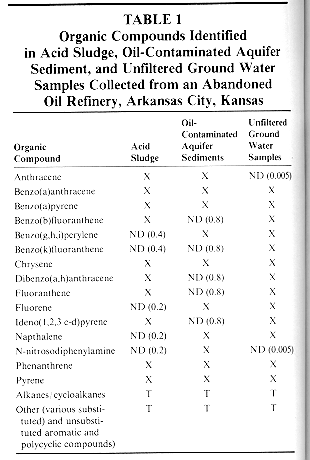
An “X” indicates that the compound was detected.
A “T” indicates that the compound was tentatively identified by the National Bureau of Standards mass-
spectral library.
The detection limits for acid sludge and oil samples ranged between 0.2 and 0.8 parts per million, which is equivalent to 0.2 and 0.8 milligrams per million, which is equivalent to 0.2 and 0.8 milligrams per kilogram.
The detection limit for water samples was 0.005 parts per million, which is equivalent to 5 micrograms
per liter.
ND = not detected.
Values in parentheses indicate detection limit for compound.
It is the purpose of this paper to show that (1) total organic carbon (TOC), which costs about $10 to $20 per sample to analyze, can be an excellent indicator of semi-volatile and non-volatile organic contaminants derived from petroleum products; and (2) analyses of TOC can be used during the initial phase of a site investigation to delineate the extent of contamination from oil refineries and, more importantly; to help identify areas that are sources of contaminants. With the large number of sities included on the U.S. Environmental Protection Agency’s National Priorities List (U.S. Environmental Protection Agency 1986a), some of which are petroleum refineries, it is important that cost-effective and rapid techniques be used to provide reliable assessments of the extent of contamination at such sites.
Methods
Samples for analysis of TOC and acid and base neutral extractable organic compounds were collected in December 1985 from monitoring and water-supply wells, surface water sites, and ponded seepage on acid-sludge wastes at an abandoned oil-refinery site in Arkansas City, Kansas (Figure 1). Unfiltered water samples were collected in dedicated Teflon® bailers from monitoring wells according to techniques presented in Ford and others (1983) and directly from the water spigot nearest the wellhead on water supply wells. The samples were decanted into 100mL (milliliter) sample bottles for TOC analysis and into 1 L (liter) bottles for analysis of acid and base-neutral compounds. Before sampling, four to eight well volumes were bailed or pumped from the wells until water temperature and specific conductance stabilized. Grab samples were collected directly in glass sample bottles from surface water and seepage sites. Samples were placed on ice and sent to the laboratory within three to seven days. Blank and duplicate samples were submitted to the laboratory for quality assurance purposes. The samples were analyzed by the U.S. Geological Survey’s water-quality laboratory in Denver, Colorado, according to gas-chromatography/mass-spectrometric methods.
Table 2
Concentration of total organic carbon, Number of individual organic
compunds identified, and total concentration of individual organic compounds identifed
in ground water, surface water, and sludge-seepage samples collected at abandoned
oil refinery, arkansas city, kansas
| Sampling Site (Fig.1) | Concentration of Total Organic Carbon (Miligrams per Liter) | Number of Organic Compounds identified | Total concentration of individual organic compounds identified (micrograms per liter) |
| USGS MW1A | 47 | 16 | 132 |
| USGS MW1B | 35 | 1 | 1 |
| USGS MW2A | 33 | 1 | 17 |
| USGS MW2B | 38 | 4 | 19 |
| USGS MW3A | 11 | 1 | 6 |
| USGS MW3B | 10 | 2 | 16 |
| USGS MW4A | 35 | 5 | 47 |
| USGS MW4B | 18 | 0 | 0 |
| USGS MW5 | 25 | 2 | 57 |
| USGS MW6 (deep) | 7 | 3 | T |
| USGS MW6 (shallow) | 6 | 1 | T |
| USGS MW7 | 73 | 72 | 4500 |
| KDHE MW1 | 6 | 3 | 10 |
| KDHE MW5 | 15 | 4 | 3 |
| Domestic Well 1 | 5 | 1 | 2 |
| Domestic Well 1 | 2 | 0 | 0 |
| Domestic Well 3 | 2 | 1 | T |
| Domestic Well 4 | 2 | 1 | T |
| Arkansas River at Highway 166 | 5 | 1 | 0 |
| Arkansas River at Highway 77 | 5 | 0 | 0 |
| Arkansas River at midpoint | 4 | 0 | 0 |
| South pond | 13 | 3 | 16 |
| Sandpit (shallow) | 10 | 1 | 3 |
| Sandpit (deep) | 9 | 1 | 3 |
| Northern waste pile | 400 | 43 | 29,300 |
| Southern waste pile | 340 | 68 | 450 |
T indicates that a trace of an organic compound was detected below the reported detection limit of 5 micrograms per liter. presented in Wershaw and others (1983).
Results
The concentration of TOC, number of organic compounds identified, and total concentration of individual organic compounds identified in ground and surface water samples from the abandoned oil-refinery site are presented in Table 2. Results of a Spearman-rho test for rank correlation (Conover 1980) are presented in Table 3. The Spearman-rho test was applied to test the null hypotheses that TOC concentrations are mutually independent of cumulative concentrations of individual compounds identified by gas chromatography/ mass spectrometry (GC/MS) or number of compounds identified by GC/ MS.~The alternative hypotheses were that large TOC concentrations are correlated with large numbers of compounds identified or large values of cumulative concentrations. The alpha level chosen for rejection of the null hypotheses was 0.05.
Discussion
Results of the correlation analysis listed in Table 3 indicate a correlation significant at the 0.01 level for both cases tested. Thus, the null hypothesis was rejected, and the significant correlations with both the number of organic compounds identified and the total concentration of individual organic compounds identified indicate that TOC can be used to identify areas of maximum contamination and to delineate areal and vertical extent of organic contamination from oil refineries and probably from other fossil fuel-related industries. Results from this investigation support the findings of Franks and others (1985), who reported a linear relationship between total organic response (total chromatogram areas of unresolved hydrocarbon envelopes) and concentration of dissolved organic carbon in water samples collected from wells at a former creosote manufacturing site in Florida.
Generally, the more total organic carbon present in a water sample, the more organic compounds are identified and the larger the cumulative concentrations of individual organic compounds. Based on the results shown in Table 3, total concentration of identified organic compounds is most strongly correlated with TOC concentration. Water samples analyzed that had less than 6 mg/L (miligrams per liter) of total organic carbon either had only a trace of a particular compound detected or no compounds detected. Thus, background TOC levels appear to be 6 mg/L or less. Water from the Arkansas River and wells sampled upgradient or adjuacent to the refinery site all had 6 mg/L or less of TOC (Figure 2).
Therefore, when sufficient organic carbon is present in a waster sample (in this case 6mg/L or more), oil-related hidrocarbon compounds could be identified (Figure 2). The reason that TOC, which has a detection limit of about 1 mg/L, can be used to indicate the presence of specific organic compounds that may occur at concentrations of only a few micrograms per liter is that as more petroleum-derived carbon is present, relatively more compounds that comprise the oil generally are present.
Identification of individual compounds in oil-contaminated samples is difficult or impossible by GC/MS with out using special cleanup procedures, such as U.S. Environmental Protection Agency method 3600 (U.S. Environment Protection Agency 1986b). This is because of interference by the many hundreds of petroleum compounds and co-eluting peaks on the chromatogram. An unresolved hydrocarbon “envelope” occurs during analysis of samples contamined with petroleum hydrocarbons (Atlas 1981), which prevents identification of most compounds present.
The majority of organic compounds present in petroleum-contamined samples may be alkanes, cycloalkanes, ketones, aldehydes, alcohols, and other compounds, which cannot be identified completely without segregation of organic-compound classes using cleanup techniques. In addition, biodegradation of petroleum hydrocarbons results in enrichment of compounds within the “unresolved envelope” which occurs during gas chromatographic analysis (Atlas 1981). This explains why compounds identified by GC/MS (where no cleanup procedures were used) in the samples shown in Table 2 accounted for less than 1 percent of the total carbon present. Nevertheless, more compounds were identified or larger concentrations of individually identified organic compounds occurred in samples containing between 6 and 400 mg/L total organic carbon.
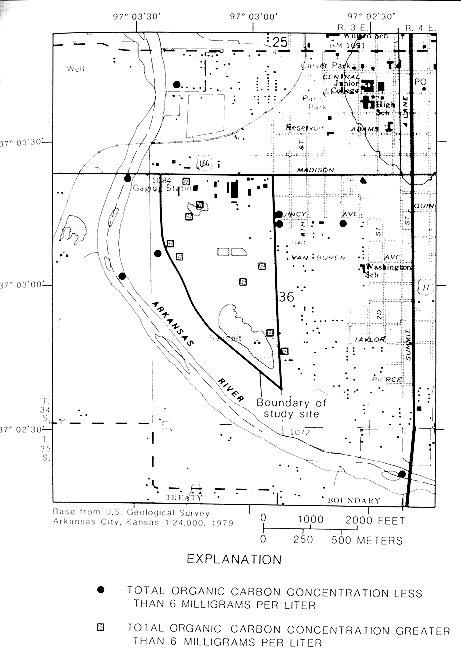
Figure 2. Distribution of total organic carbon in alluvial aquifer
in vicinity of an abandoned oil refinery, Arkansas City, Kansas,
December 1985 through July 1986.
TOC data alone certainly would not be sufficient to evaluate hazards posed by refinery wastes (or similar wastes containing complex fossil-fuel-related compounds). However, data presented here indicate that concentrations of TOC can be used effectively to delineate petroleum-related ground water contamination and to help identify sources of ground water contaminants.
As an example, much information about the extent of contamination could be obtained at a relatively small cost in alluvial valley settings where depth to water is shallow (less than 20 feet [6.1 meters]). After selection of a sampling-point distribution that would represent an area adequately, samples could be collected from each sampling point using the temporary well shown schematically in Figure 3. A 1.5-inch- (3.8,cm) diameter sandpoint and casing is driven through and ahead of the hollowstem auger flights equipped with a synthetic auger plug (to prevent entry of water and sand into the casing until reaching the desired sampling depth). The sample is collected with a bailer or pump. Receipt of analytical data for TOC from most laboratories is generally less than four weeks so that the information is available quickly for mapping and interpretation. Such data obtained from a large number of sampling points during the initial phase of a site investigation will give an estimate of the extent of hydrocarbon contamination and serve to guide the subsequent placement of monitoring wells for more detailed sampling.
Disclaimer
The use of trade names in this paper are for identification purposes only and does not constitute endorsement by the U.S. Geological Survey.
References
Atlas, R.A. 1981. Microbial degradation of petroleum hydrocarbon-an environmental perspective. Microbiological Reviews, v. 45, pp. 180-209.
Bigda, R.J. 1982. Can black wastes turn into gold? Pollution Engineering, August, pp. 25-27.
Coleman, W.E., J.W. Munch, R.P. Streicher, H.P. Ringhand, and F.C. Klopfler. 1984. The identification and measurement of compounds in gasoline, kerosene, and number 2 fuel that partition into the aqueous phase after mixing. Architectural Environmental Contamination Toxicology, v. 13, pp. 171-178.
Conover, W.J. 1980. Practical nonparametric statistics. New York, John Wiley and Sons Inc., 493 pp.
Ford, P.J., P.J. Turina, and D.E. Seeley. 1983. Characterization of Hazardous Waste Sites – A Methods Manual, volume lI. Available sampling methods. U.S. Environmental Protection Agency, EPA-600/4-83040.
Franks, B.J., D.F. Goerlitz, and M.J. Baedecker. 1985. Defining extent of contamination using onsite analytical methods. Petroleum Hydrocarbons and Organic Chemicals in Ground Water- Prevention, Detection, and Restoration Conference Proceedings, November 13-15, 1985. National Water Well Association, 581 pp.
Goerlitz, D.F., E.M. Godsy, D.E. Troutman, and B.J. Franks. 1986. Chemistry of ground water at a creosote works, Pensacola, Florida. U.S. Geological Survey Water-Supply Paper 2285, chapter G, pp. 49-53.
Kalichevsky, V.A. and K.A. Kobe. 1956. Petroleum refining with chemicals. Amsterdam, Elsevier Publishing Co., 780 pp.
Karickhoff, S.W., D.S. Brown, and T.A. Scott. 1979. Sorption of hydrophobic pollutants on natural sediments. Water Resources, v. 13, pp. 241-248.
Means, J.C., S.G. Wood, J.J. Hassett, and W.L. Banwart. 1980. Sorption of polynuclear aromatic hydrocarbons by sediments and soils. Environmental Science and Technology, v. 14, pp. 1524-1528.
Pereira, W.E. and C.E. Rostad. 1986. Geochemical investigations of organic contaminants in the subsurface at a creosote works, Pensacola, Florida. U.S. Geological Survey Water-Supply Paper 2285, pp. 33-40.
Schwartzenbach, R.P. and J. Westall. 1981. Transport of non-polar organic compounds from surface water to ground water — Laboratory sorption studies. Environmental Science and Technology, v. 15, pp. 1350 -1367.
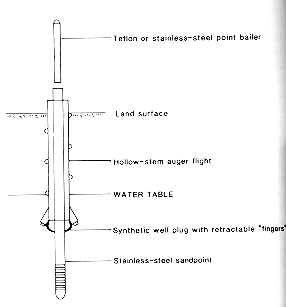
Figure 3. Temporary well to collect water samples.
U.S. Environmental Protection Agency. 1979. Federal Register, v. 44, no. 233, Monday, Dec. 3.
U.S. Environmental Protection Agency. 1986a. Amendment to National Oil and Hazardous Substances Contingency Plan national priorities list, final rule and proposed rule. Federal Register, v. 51, no. 111, June 10, pp. 21053 -21112.
U.S. Environmental Protection Agency. 1986b. Test methods for evaluating solid waste – volume 1C, Laboratory manual physical/ chemical methods. U.S. Environmental Protection Agency, unnumbered pages.
Wershaw, R.L., M.J. Fishman, R.R. Grabbe, and L.E. Lowe, eds. 1983. Methods for the determination of organic substances in water and fluvial sediments. U.S. Geological Survey Techniques of Water Resources Investigations, Book 5, Laboratory Analysis, Chapter A3, 173 pp.
Biographical Sketch
Timothy B. Spruill graduated from the University of Wisconsin-Madison with an M.S. in water resources management in 1977. He worked for one year with the Wisconsin State Geological and Natural History Survey.
Since 1978, he has been employed as a hydrologist with the U.S. Geological Survey (1950 Constant A ve., Lawrence, KS 66050). Spruill has been involved with design and operation of a statewide ground water quality monitoring network. He has also conducted projects investigating effects of irrigated agriculture, mining, and various hazardous waste sites on ground and surface waterquality. Currently, he is involved with a project investigating hydrologic and geochemical factors that affect transport and fate of contaminants derived from oil refining activities.
